Don’t Let the Next CT Downpour Wash Away Your Yard: A Guide to Bristol Drainage Solutions
Every homeowner in Bristol, Connecticut knows that our local weather keeps us on our toes. From rapid spring thaws to torrential summer thunderstorms and late-autumn downpours, Central Connecticut gets its fair share of heavy precipitation. While we love the lush, green landscapes that all this rain brings, water can quickly shift from a life-giving resource into a destructive force if your property isn’t properly graded or equipped to handle the volume.
If you’ve noticed pooling water on your lawn days after a storm, mud washing across your driveway, or a damp, musty smell creeping into your basement near Federal Hill or the Pequabuck River basin, you’re dealing with a drainage problem. Left unaddressed, poor drainage doesn’t just ruin your grass—it threatens your home’s foundation, devalues your property, and turns your outdoor living space into an unusable swamp.
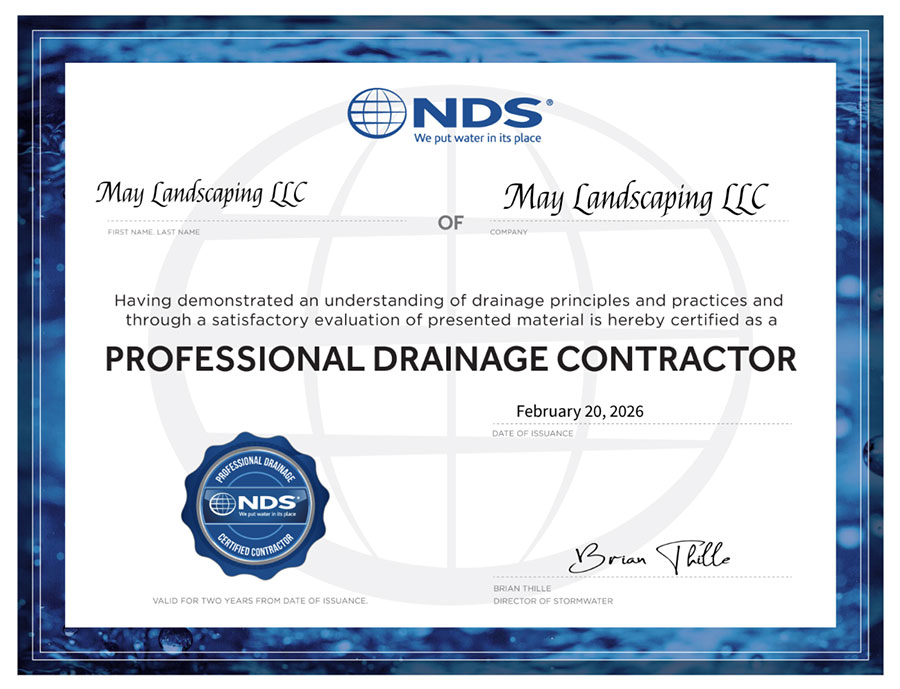
At May Landscaping LLC, we specialize in diagnostic and permanent drainage solutions. Let’s dive into why Bristol properties are uniquely vulnerable to water damage, how to spot the early warning signs, and the professional drainage interventions that will protect your investment for decades to come.
The Unique Topography and Soil Challenges of Bristol, CT
To fix a drainage issue, you first have to understand why water behaves the way it does on your specific plot of land. In Bristol and the surrounding Hartford County area, homeowners face a unique combination of topographical and geological challenges.
-
The Slopes and Hills: Bristol isn’t flat. From the rolling terrain of Chippens Hill to the steep declines leading down to our local streams, many homes are built on slopes. While a sloped yard can offer beautiful views, it also means your property might be on the receiving end of thousands of gallons of runoff rushing down from your uphill neighbors.
-
Dense, Clay-Heavy Soils: Much of the soil in Central Connecticut contains a high concentration of dense clay and glacial till. Unlike sandy soils that absorb water like a sponge, clay acts like a stubborn barrier. When a heavy storm hits, the ground quickly becomes saturated, forcing excess water to sit on the surface or rush violently across your landscape, stripping away topsoil and mulch.
-
High Water Tables: Properties situated in lower-lying areas or near local water bodies often contend with a high water table. When the water table rises during rainy seasons, the ground loses its ability to absorb any more moisture, forcing water upward into crawlspaces and basements.
5 Warning Signs Your Property Has a Drainage Crisis
Water damage can be incredibly deceptive. It often starts small, invisible to the untrained eye, before escalating into a costly emergency. Keep a lookout for these five critical warning signs on your property:
-
Persistent Standing Water: If a heavy rain leaves puddles that take more than 24 to 48 hours to disappear, your soil is either heavily compacted or there is nowhere for the water to escape.
-
The “Sponge Lawn” Effect: Walking across your lawn shouldn’t feel like stepping on a soaked mattress. Squishy, waterlogged turf suffocates grass roots, invites lawn diseases, and makes routine lawn maintenance impossible without leaving deep ruts.
-
Migrating Mulch and Silt Deposits: Look at your garden beds. Is your mulch regularly washing out onto your lawn or driveway after a storm? Are you finding patches of fine silt deposited in random areas of your yard? This is a clear indicator of unchecked surface runoff.
-
Erosion Trenches: Small gullies or trenches carved out of your lawn or dirt pathways mean water has established a high-velocity path across your yard, actively stripping away your landscaping.
-
Foundation Cracks and Basement Moisture: This is the most dangerous sign. If water pools against your home’s foundation, hydrostatic pressure will eventually force that moisture through solid concrete, causing basement flooding, mold growth, and structural shifting.
Professional Drainage Solutions That Work
A quick fix from a big-box hardware store rarely solves a serious drainage issue. Throwing down plastic piping without calculating the proper slope or water volume will only waste your time and money. True water management requires professional-grade engineering, light excavation, and a deep understanding of gravity and hydraulics.
Here are the most effective drainage systems May Landscaping LLC implements for Bristol homeowners:
1. French Drains (Subsurface Drainage)
A French drain is the gold standard for managing subsurface water and soggy lawns.
   [ Surface Water / Soggy Turf ]
                 │
                 ▼
   ┌───────────────────────────┐  <-- Geotextile Fabric Wrap
   │   ░░░ Perforated ░░░      │
   │   ░░ Clean Stone ░░░      │
   │       ┌───────┐           │
   │       │ O O O │           │  <-- Perforated Pipe (Sloped)
   │       └───────┘           │
   └───────────────────────────┘
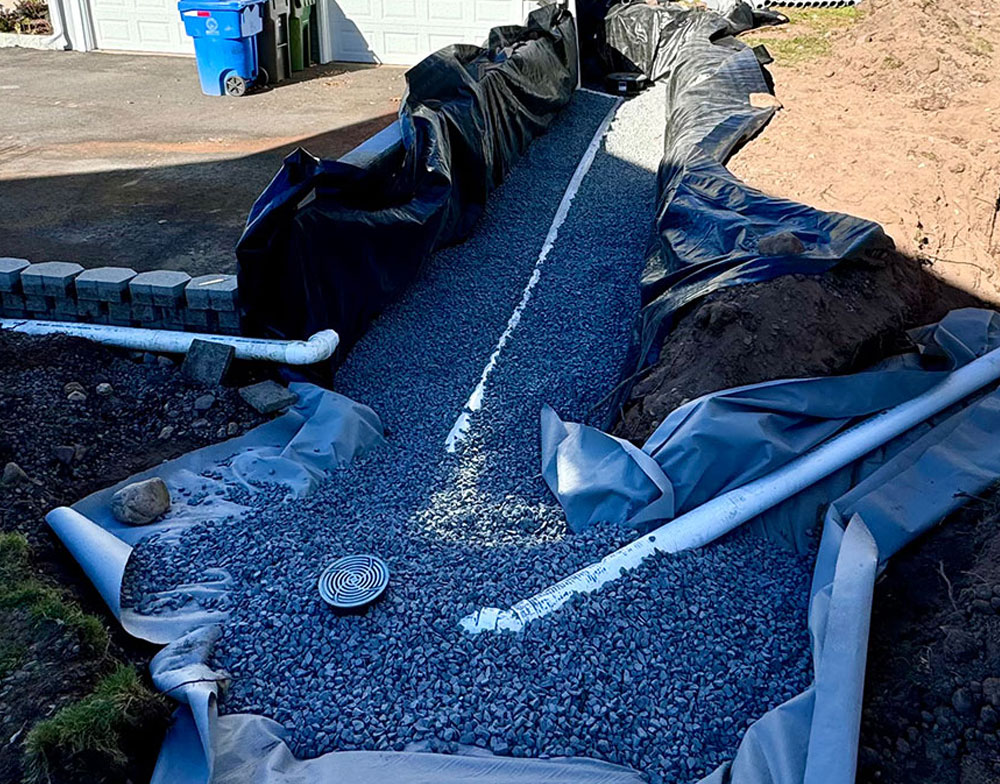
We excavate a trench along the problematic area, line it with heavy-duty geotextile fabric, lay down a perforated, rigid PVC pipe, and fill the trench with clean, washed stone. Water naturally seeks the path of least resistance, filtering through the stone into the pipe, which safely channels it away from your home to a designated discharge zone.
2. Catch Basins and Downspout Extensions
Your roof captures an immense amount of water during a storm. If your downspouts empty directly next to your foundation, you are actively flooding your own basement. We install underground downspout extensions that tie your gutters directly into an enclosed piping system. For low spots on driveways, patios, or lawns, we install heavy-duty catch basins with grates to trap surface debris while whisking water away immediately.
3. Strategic Re-Grading and Light Excavation
Sometimes, the best solution is altering the land itself. Using specialized, low-impact excavation equipment, our team can re-shape the contours of your yard. We build gentle swales (shallow, grass-lined channels) that naturally redirect water around your home rather than toward it. We ensure that the first ten feet of soil surrounding your foundation slopes away from your home at a proper decline.
4. Dry Wells and Infiltration Systems
Where does all that collected water go? In municipal areas like Bristol, you cannot simply dump your property’s excess water onto your neighbor’s lawn or into the street. A dry well is an eco-friendly underground storage structure that collects large volumes of runoff and allows it to slowly, safely dissipate back into the deep water table without causing surface flooding.
Why Choose May Landscaping LLC?
When dealing with drainage, accuracy matters down to the fraction of an inch. A system sloped incorrectly will collect stagnant water, creating a breeding ground for mosquitoes and worsening your problems.
At May Landscaping LLC, we don’t guess—we measure. We analyze your property’s pitch, soil composition, and runoff patterns to design a custom system tailored explicitly to your land. Our light excavation equipment allows us to move serious amounts of earth efficiently while minimizing damage to your existing lawn and landscapes.
Don’t wait for the next major New England storm to find out your yard can’t handle the pressure. Protect your turf, secure your foundation, and reclaim your outdoor space.
Ready to dry out your yard for good? Contact May Landscaping LLC today to schedule your comprehensive on-site drainage consultation.